× -
We're eager to get your ring started, so we're offering
$25 USD off your order
if you complete purchasing your ring within the next:
$25 USD Off* expires in:
Minutes
:
Seconds
Meteorite Ring Info

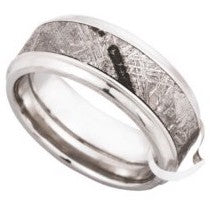
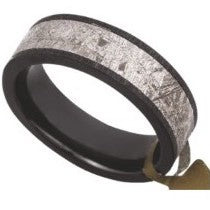
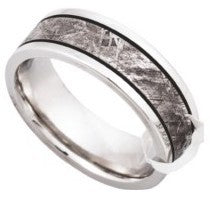
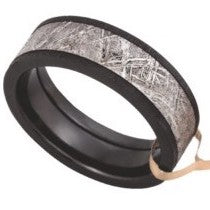
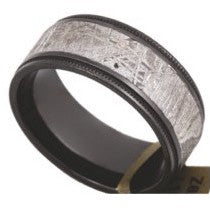
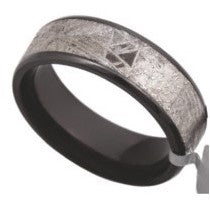
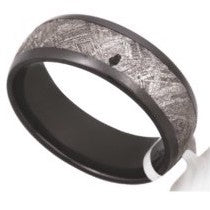
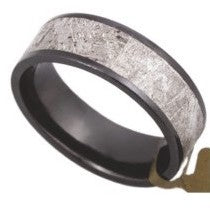
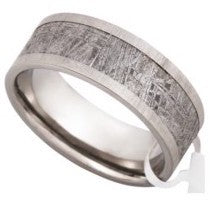
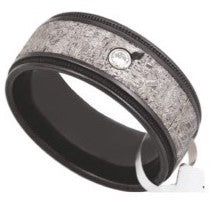
All Revolution meteorite rings are inlaid with genuine Gibeon Meteorite — formed in space four billion years ago and recovered from the Namibian desert. Every piece carries a crystalline pattern that cannot be manufactured or replicated.

What is a meteorite ring?

A meteorite ring contains actual extraterrestrial metal — iron-nickel alloy that originated outside our solar system, traveled through space for billions of years, survived atmospheric entry, and was recovered on Earth. It is not synthetic. It is not manufactured. It is not a reproduction. Every piece of meteorite in a ring was once flying through space.

The meteorite used in Revolution rings is called Gibeon meteorite, named after the town of Gibeon in Namibia, Africa where it was recovered. When it entered Earth's atmosphere it exploded and scattered pieces across the Namibian desert over an area 171 miles long and 62 miles wide. Gibeon is an iron meteorite — composed primarily of iron and nickel with trace amounts of other elements.

What is the Widmanstätten pattern?

The defining feature of Gibeon meteorite — and the reason it's used in rings — is the Widmanstätten pattern. This is a crystalline structure of intersecting nickel-iron bands that becomes visible when the meteorite is cut, polished, and etched with a mild acid.

The Widmanstätten pattern only forms over millions of years of extremely slow cooling — a rate of approximately 1°C per million years. It cannot be replicated in a lab. It cannot be manufactured. It is a scientific fingerprint that proves the material is genuine.

If you see the pattern, it's real.

Are all meteorite rings made from Gibeon meteorite?

Most quality meteorite rings use Gibeon because of its consistent crystalline pattern, relative stability, and availability. Other meteorite types exist — including Muonionalusta and Campo del Cielo — but Gibeon is the industry standard for jewelry applications.

Low-quality rings sometimes use meteorite dust compressed into resin — this is not the same thing and should not be sold as a meteorite ring. When you buy from Revolution, you're getting actual Gibeon meteorite. Not dust. Not simulant. The real thing.

How is meteorite used in a ring?

Meteorite is used as an inlay — a thin slice set into a channel in a metal band — rather than as the entire ring body. Pure meteorite is brittle and porous, making it unsuitable as a standalone ring material. The metal base provides structural integrity while the meteorite provides the visual drama.

The inlay can be positioned in the center, off-center, or along the edge of certain metals — making it a versatile option for custom ring designs. Revolution pairs meteorite with materials including titanium, black zirconium, Damascus steel, gold, and cobalt chrome.

How can I tell the meteorite in my ring is authentic?

There are four reliable ways to confirm your meteorite is genuine:

1
Widmanstätten Pattern The crystalline cross-hatch pattern unique to Gibeon meteorite. It should be visible to the naked eye. Fakes rarely replicate it convincingly up close.
2
Natural Inclusions Authentic meteorite has tiny holes or dark spots caused by trace minerals. Inclusions prove natural origin — no two pieces are alike.
3
Magnet Attraction Real Gibeon meteorite is primarily iron — a magnet will be drawn to it. Most imposters use non-magnetic materials.
4
Potential for Rust Genuine meteorite can rust due to its iron content. If it does rust during the warranty period, it's covered and easy to remove.
Price is also a signal — genuine Gibeon meteorite is not cheap. If a "meteorite ring" costs $40, it isn't. Revolution's meteorite comes from verified, classified Gibeon specimens.

What are meteorite inclusions?

Inclusions are tiny holes or dark spots on the surface of the meteorite, often caused by traces of certain metals. Rather than being flaws, they are important clues to the meteorite's authenticity and cosmic origin — no two pieces are alike.

Normal Inclusions

Normal seam near the top of the ring

Normal seam near the top of the ring

Inclusion revealed after diamond setting

Inclusion revealed after diamond setting and etching

Large inclusion — structurally sound

Near the largest inclusion you'd see — structurally sound

Fluctuations in pattern and color

Natural fluctuations in pattern, color, and texture

Another example of coloring and texture

Another example of natural coloring and texture

Rare water-drop-like inclusion

Uncommon water-drop-like inclusion — natural occurrence

Beautiful Widmanstätten pattern with color variation

Beautiful Widmanstätten pattern with color variation

Common black spot inclusions

Common black spot inclusions

Less common pattern and coloring

Less common pattern and coloring variety

Another black spot example

Another example of black spot inclusions

Unusual cluster of many small black spots

Unusual cluster of many small black spots

Why do meteorite rings have seams?

Meteorite inlays begin as flat strips of metal. They are then carefully wrapped around the outside of the band and joined together at a seam. This seam is a natural part of the construction process and a hallmark of genuine meteorite inlay work.

Do meteorite rings last?

Years of wear can cause the Widmanstätten pattern to gradually fade. However, the meteorite can be re-etched at any time to restore the lines and make it look new again. Re-etching is included under the warranty period. With basic care, a meteorite ring will last a lifetime — the material has already survived four billion years of space travel.

Is meteorite hypoallergenic?

Meteorite contains nickel, which is a common allergen. Most people have no reaction — but if you have a known nickel sensitivity or have reacted to jewelry before, it's worth knowing before you order.

If you have a nickel allergy or sensitivity, test carefully before committing to a meteorite ring.

How do you take care of a meteorite ring?

Keep it dry when possible. Remove it before swimming, bathing, or prolonged water exposure. Moisture is the primary enemy of iron meteorite.
Clean with a soft dry cloth. For more thorough cleaning, mix baking soda and water into a paste and gently scrub with a soft bristle toothbrush. Rinse thoroughly and dry completely — allow to air dry overnight before applying oil.
Apply a small amount of oil to the meteorite surface occasionally — Renaissance wax, mineral oil, or gun oil all work well. This creates a barrier against moisture and helps maintain the appearance of the Widmanstätten pattern.
Store it somewhere dry when not wearing it. A ring box or dry drawer is fine. Avoid leaving it in humid environments like a bathroom countertop.

Does meteorite rust?

In general, Gibeon meteorite should remain rust-free through normal everyday use. Wearing the ring daily actually helps — the natural oils in your skin transfer to the meteorite surface and provide protection.

If rust spotting does appear, it is a normal part of owning a genuine iron meteorite ring and doesn't indicate a defect. It can be removed with a small amount of rust remover designed for metal, followed by re-oiling.

If your ring ever rusts during the warranty period, it's fully covered under our Lifetime Warranty — the rust is easy to remove and the ring can be restored to like-new condition.

How do I keep my meteorite ring from rusting?

The most important step is to keep your ring away from harsh chemicals and salt water. After cleaning, applying a thin coat of mineral oil — or Renaissance wax, or gun oil — will seal the surface and provide lasting protection against moisture and oxidation.

Regular wear helps too. The natural oils in your skin do a lot of the protective work on their own.

Ready to own a piece of space? Browse our meteorite ring collection and find the combination that's right for you.

See our Meteorite Rings