by Matt McDaniel 6 min read
Material Guide
Yes. Titanium has the highest strength-to-weight ratio of any metallic element, it is hypoallergenic enough to be used in medical implants, and it holds its light grey color permanently. For a band you plan to wear every single day, that combination is very hard to beat.
90 / 6 / 4
Titanium, aluminium, vanadium
No. 1
Strength to weight of any metal
3 to 24
Sizes, in quarter increments
One
Titanium rings at Revolution use Ti6AL4V, an aerospace-grade alloy that is 90 percent titanium, 6 percent aluminium, and 4 percent vanadium. It is more expensive and harder to work than commercially pure titanium, and significantly stronger.
That distinction does more work than it looks like. Commercially pure titanium, roughly 99 percent, is the common choice across the jewelry industry. The rings here use the aerospace alloy instead, so two rings both sold as titanium are not necessarily the same metal. The full titanium spec sheet has the rest of the numbers.
That grade matters because a ring is a thin loop of metal wrapped around a bone you use all day. Titanium’s strength-to-weight advantage is why the element turns up in aerospace and military work, from naval ships and racing engines to spacecraft. In a band it means the ring holds up to a great deal of abuse without cracking, breaking, or bending.
Two
Very light. That is the weight rating titanium carries in our own material comparison, and the highest strength-to-weight ratio of any metallic element is what makes it possible. You can go wide without going heavy.
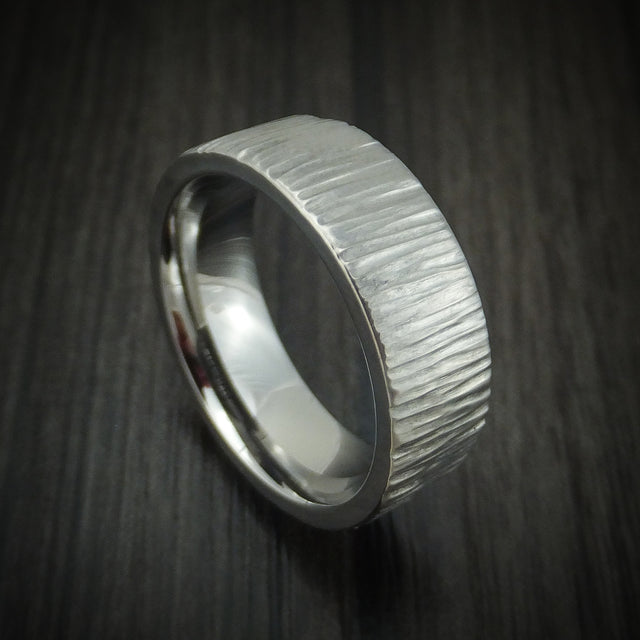
Width depends on the design. Many catalog bands carry a width selector, usually 6 mm through 9 mm and sometimes starting at 5 mm, while others are built at one fixed width, like the 7 mm Classic Style or the flat 7 mm tree bark band pictured below. Build one from scratch in the ring builder and the range opens up to every millimetre from 2 mm to 10 mm. If you have no idea which number is yours, we wrote a whole guide to ring width.
Either way the interior is comfort fit, the rounded profile we recommend for wider rings and larger knuckles. Getting the size itself right matters more than the material does, so if you have not measured yet, start with how to measure at home or the ring sizing guide.
For scale: a titanium ring is noticeably lighter than a gold one, gold itself runs medium to heavy depending on karat and width, and tungsten is the heaviest ring material we offer. Titanium is the one that gets out of your way.
Three
Yes, and excellent for sensitive skin. Titanium’s hypoallergenic properties are the reason it is used so extensively in medicine, from surgical implants to fixing broken bones.
If you react to costume jewelry, a watch back, or a belt buckle, nickel is the usual culprit. Nickel-containing alloys are what trigger most jewelry sensitivities, which is why white gold, which often contains nickel, and meteorite, which is an iron-nickel alloy, are the two materials we flag for reactive skin. The Ti6AL4V alloy contains none of it. Titanium is also resistant to corrosion.
Four
Almost anything. Titanium accepts almost any inlay, and it carries more surface finishes than most metals in the catalog.
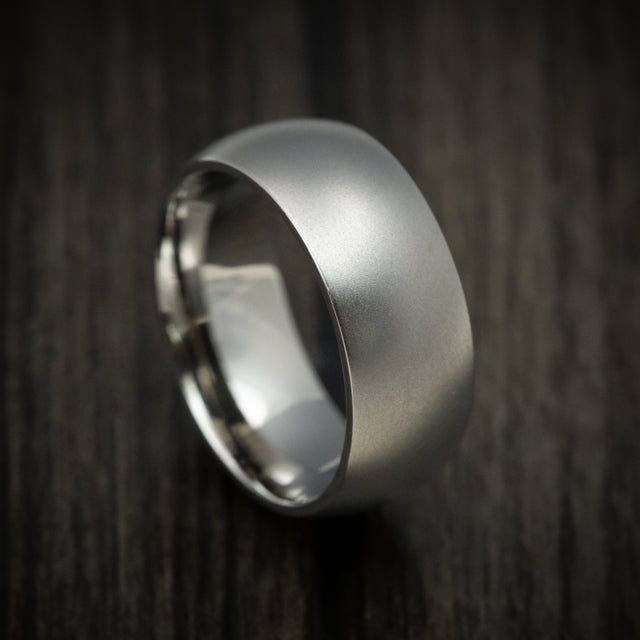
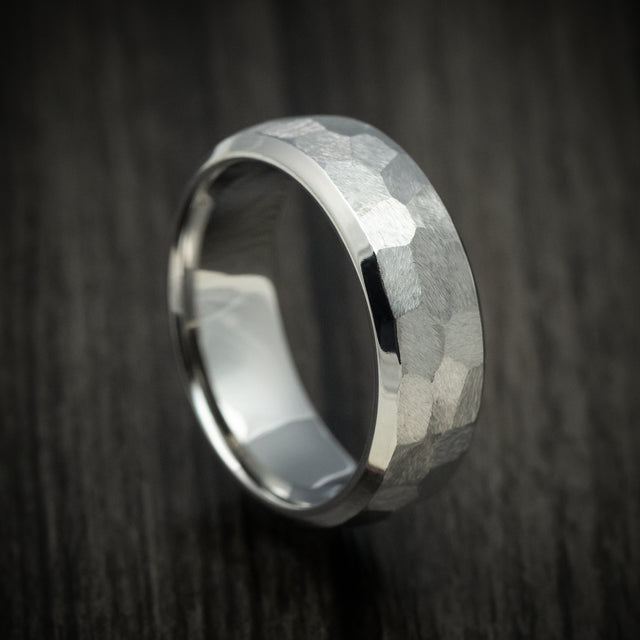
On texture, the builder offers seventeen titanium finishes: polish, satin, angle satin, cross satin, stone, angle stone, bead, sand, hammer, machine, distressed, rock, rock polish, stipple, and three separate tree bark textures. Those sit on profiles running from flat and domed through beveled, stepped, grooved, milgrain-edged, rounded, and concave. Finish is not only a look decision. Matte and brushed finishes wear better than polished, which shows micro-scratches sooner, so if you want the ring to age quietly, start there. The three bands pictured above are a bead finish on a domed profile, a rock finish, and a flat tree bark.
On inlays, the range is the real argument for titanium. The builder will set:
You can run two outside features at once, and lab-grown diamonds and gemstones can be set into the band on top of that.
To see the options laid out rather than listed, open the ring builder or browse the titanium collection. For how each inlay material behaves, start with the full inlay guide, and for what happens after you hit order, how custom ring design works.
Five
Titanium sits in the middle of the board on purpose. It is the versatile option, not the extreme one. If you are still narrowing the field, our guide to choosing a ring material walks the whole decision.
Six
Titanium rings need no special care. They can be worn in effectively any environment, and as long as the ring contains no meteorite, mild soap and water or ordinary jewelry cleaner is all it asks for. That is a big part of why it keeps turning up in our roundup of rings for an active lifestyle.
The metal will scuff and pick up wear marks over time. That is the honest trade for a band that will not crack, bend, or lose its color. If you would rather it stay sharp, refinishing and normal wear and tear are covered under the lifetime warranty, with no charge for the service.
The short version
Pick titanium when you want to forget you are wearing it
It is rated very light and excellent for sensitive skin, it accepts almost any inlay, and the metal itself will not fade or change color. Gold, titanium, and Damascus steel are the three materials we list as offering the most extensive customization options.
Titanium Questions
Are titanium rings good for everyday wear?
Yes. Titanium holds up to a great deal of abuse without cracking, breaking, or bending, and it needs no special care. It will scuff over time, which is normal for any worn metal.
Do titanium rings scratch?
Titanium is hard but can scratch over time. Matte and brushed finishes wear best; polished finishes show micro-scratches sooner. Refinishing and normal wear and tear are covered under the lifetime warranty, with no charge for the service.
Are titanium rings hypoallergenic?
Yes, and excellent for sensitive skin. Titanium’s hypoallergenic properties are why it is used so extensively in medical implants. The Ti6AL4V alloy is titanium, aluminium, and vanadium, with no nickel, and nickel-containing alloys are what trigger most jewelry sensitivities.
What finish wears best on a titanium ring?
Matte and brushed finishes wear better than polished. A polished titanium surface shows micro-scratches sooner, while matte and brushed textures like rock, tree bark, and sand blast absorb daily wear far less visibly.
Does a titanium ring change color over time?
No. Titanium maintains its light grey color over time and will not fade or change. It is also resistant to corrosion.
Co-Owner & Marketing Director of Revolution Rings. For over a decade, Matt has curated men's wedding bands in non-traditional materials including Damascus steel, meteorite, black zirconium, and superconductor. Read more about Matt →
by Matt McDaniel 5 min read
Meteorite, gold, dinosaur bone, carbon fiber, mokume gane. What each ring inlay actually is, how wide it can go, and where on the band to place it.
by Matt McDaniel 6 min read
Superconductor rings are cut from real niobium-titanium and copper cable used in MRI machines and particle accelerators. Here is how the pattern is made.